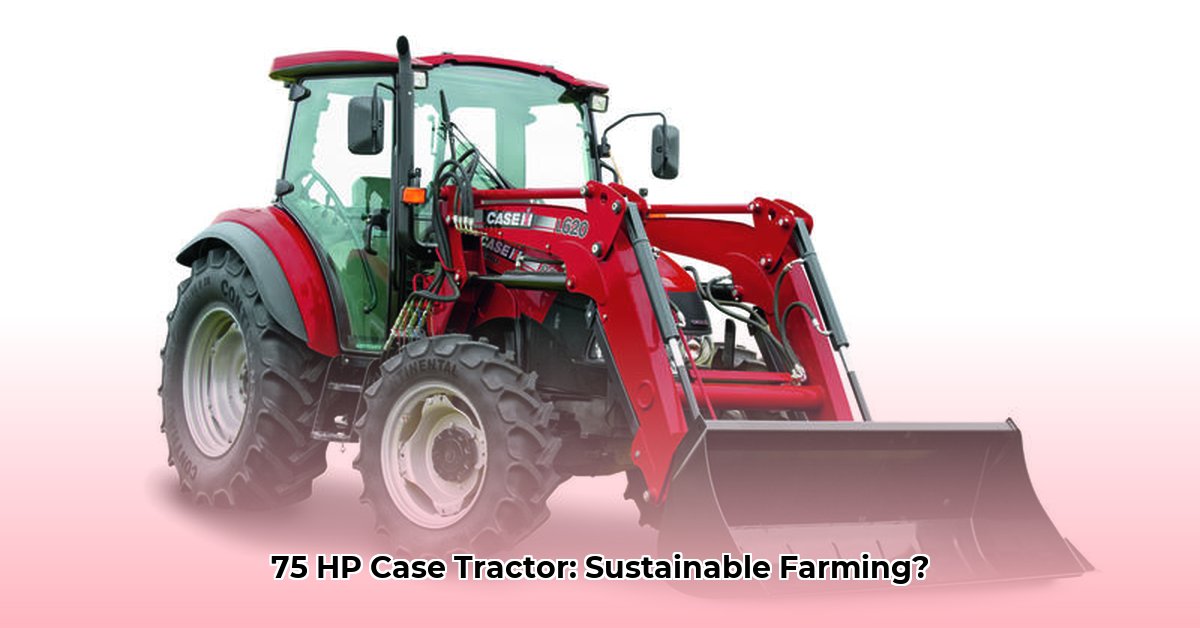
The Case IH Farmall 75A, a 75 horsepower tractor, presents a compelling case for farmers seeking a balance between affordability, power, and sustainable agricultural practices. This review analyzes its performance, durability, environmental impact, and overall suitability for modern farming needs, focusing on its unique design choice of omitting a Diesel Particulate Filter (DPF). For more Case IH tractor information, visit Case IH Tractors.
Power and Efficiency: A Practical Assessment
The Farmall 75A delivers 74 horsepower at 2300 ERPM, sufficient for a range of tasks. Its key differentiator is the absence of a DPF, leading to lower initial purchase costs and simplified maintenance. This directly reduces upfront investment and ongoing expenses. However, this design choice necessitates a thorough examination of its long-term environmental implications and compliance with evolving emission regulations. Is the immediate cost savings offset by potential future liabilities? That's a question we will address through this review.
Durability and Maintenance: A Long-Term Perspective
The Farmall 75A boasts robust construction, featuring reinforced axles and transmission components designed for extended lifespan and reduced downtime. This translates to fewer repairs and lower overall operational costs. The lack of a DPF simplifies maintenance, further reducing expenses. However, a lack of a DPF could lead to higher long-term maintenance if not properly maintained. Therefore, a proactive maintenance schedule becomes crucial for maximizing the tractor’s lifespan and minimizing environmental impact.
Sustainability Assessment: Weighing the Trade-offs
The absence of a DPF is a double-edged sword. While it lowers initial costs and simplifies maintenance, it raises environmental concerns about potential long-term particulate emissions. This design choice may comply with current emission standards, but its compliance with future, potentially stricter regulations remains uncertain. This uncertainty necessitates a careful assessment of its environmental consequences and long-term sustainability.
Cost-Benefit Analysis: A Financial Evaluation
The Farmall 75A's lower initial purchase price and reduced maintenance costs are significant advantages. However, the potential for increased long-term particulate emissions and possible future non-compliance with stricter environmental regulations must be factored into the overall cost equation. A comprehensive cost-benefit analysis is critical to determine if the short-term financial gains outweigh potential long-term environmental and financial liabilities.
| Factor | Advantages | Disadvantages |
|---|---|---|
| Initial Purchase Price | Lower than comparable DPF-equipped tractors. | N/A |
| Maintenance Costs | Lower complexity leads to reduced maintenance. | Potential for higher long-term repair costs without DPF. |
| Fuel Efficiency | Good, though dependent on usage and maintenance. | Not as efficient as some newer models with DPFs. |
| Environmental Impact | Lower immediate emissions due to lack of DPF. | Potential for higher long-term particulate emissions. |
| Regulatory Compliance | Meets current standards. | Uncertain future compliance with stricter regulations. |
Target Audience and Use Cases: Identifying the Ideal Farmer
The Farmall 75A best suits smaller farms, operations with high-torque requirements, and those prioritizing affordability and reliability above all else. Farmers prioritizing immediate cost savings and simpler maintenance will find it attractive. However, those prioritizing long-term sustainability above all must carefully weigh the advantages and disadvantages.
Comparison with Competitors: A Market Overview
Direct comparison with tractors featuring SCR technology and DPFs is crucial. While the Farmall 75A offers short-term economic benefits, a thorough comparison reveals the long-term environmental and financial trade-offs. This comparative analysis provides a comprehensive perspective on sustainable farming practices.
Conclusion: A Balanced Perspective
The Case IH Farmall 75A offers a compelling proposition for budget-conscious farmers requiring high-torque performance. Its low initial cost and simplified maintenance are significant advantages. However, the lack of a DPF raises potential long-term environmental concerns and regulatory compliance questions. Therefore, a thorough risk assessment and cost-benefit analysis are essential before considering this tractor for sustainable agricultural practices.
Risk Assessment Summary
| Risk Factor | Likelihood | Impact | Mitigation |
|---|---|---|---|
| Changes in Emission Laws | High | High | Continuous monitoring of regulations and proactive adaptation strategies. |
| Unexpected Repair Costs | Medium | Medium | Regular preventative maintenance, thorough pre-purchase inspection. |
| Fuel Consumption Variation | Low | Medium | Optimized operational practices and diligent fuel monitoring. |
| Parts Availability | Low | Low | Verification of dealer support and parts inventory before purchase. |
This review provides a balanced view, aiding farmers in making informed decisions aligned with their specific needs and priorities. Remember, sustainable agriculture requires a holistic approach, weighing economic considerations with environmental responsibility.